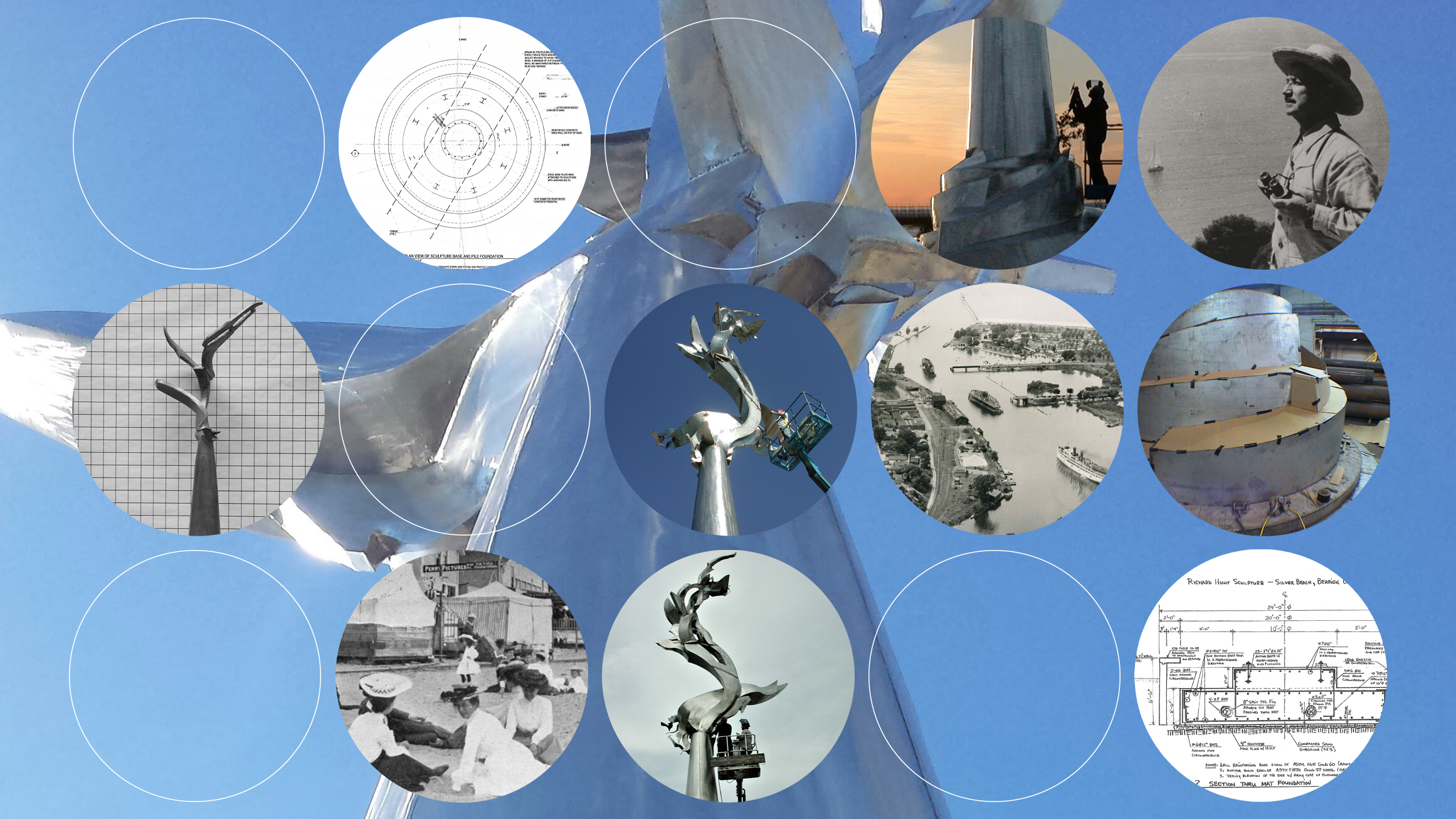
WHAT MAKES IT STAND?
Richard Hunt and the engineering team considered wind from Lake Michigan, the sculpture’s weight, and the sandy ground when planning its foundation. Explore the original drawings and notes below.
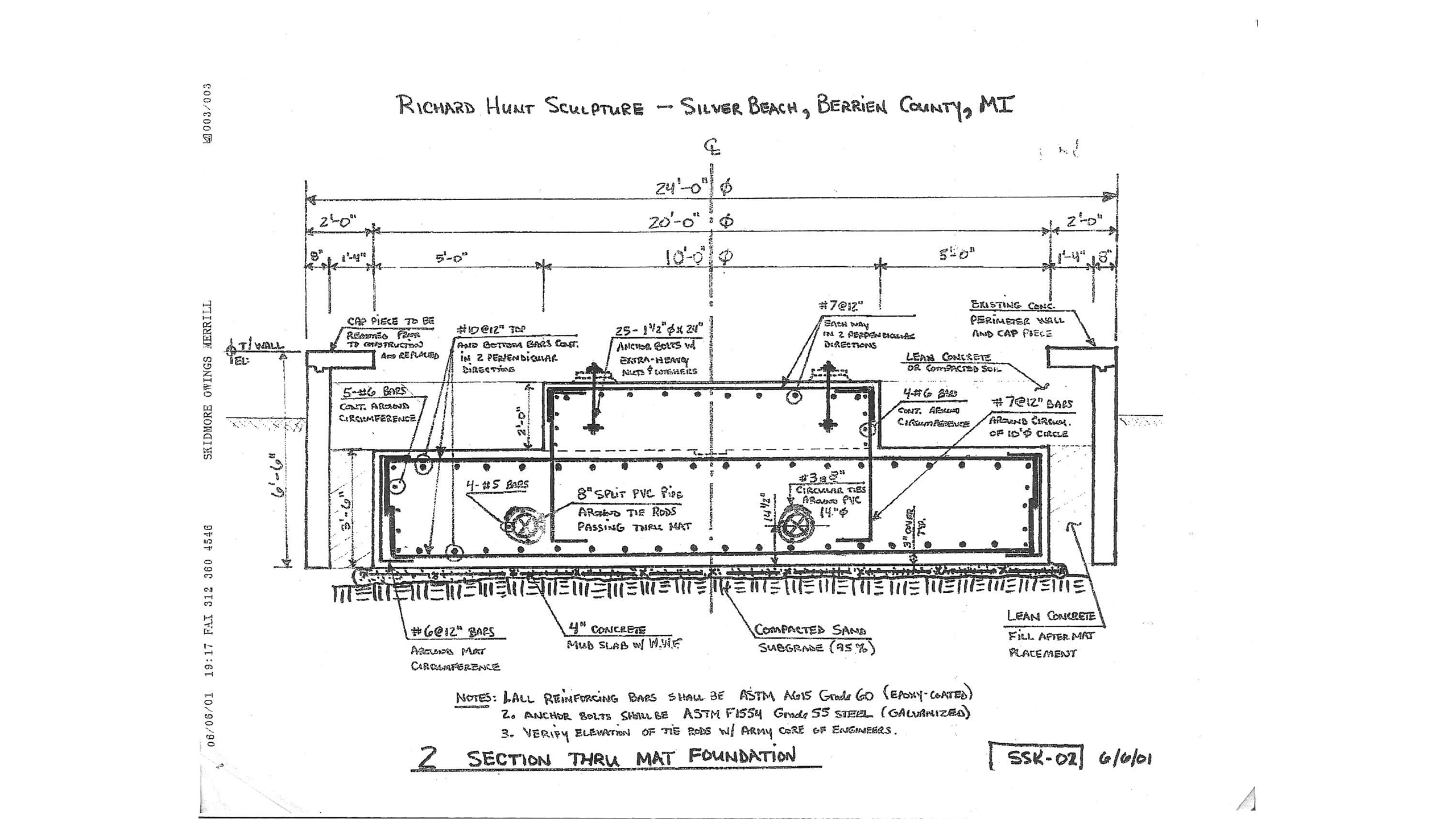
DRAFT 1 SECTION DRAWING
For many sculptures like And You, Seas, a carefully planned foundation is a necessary part of the design process. This hand-drawn sketch details the first concept for the foundation of And You, Seas: a mat foundation. After studying the site and working with the U.S. Army Corps of Engineers, the team realized a different support system would be necessary.
Documents courtesy of Skidmore, Owings & Merrill, Chicago, IL.
Read the drawing description
A side cutaway shows a reinforced-concrete mat 20 feet across, with a raised central portion 10 feet across and 2 feet high. The lower slab is 3 feet thick. Steel reinforcing bars run through the concrete, and anchor bolts attach the sculpture above. Beneath the mat are a concrete mud slab and compacted sand. Existing perimeter walls stand outside the mat.
Documents courtesy of Skidmore, Owings & Merrill, Chicago, IL.
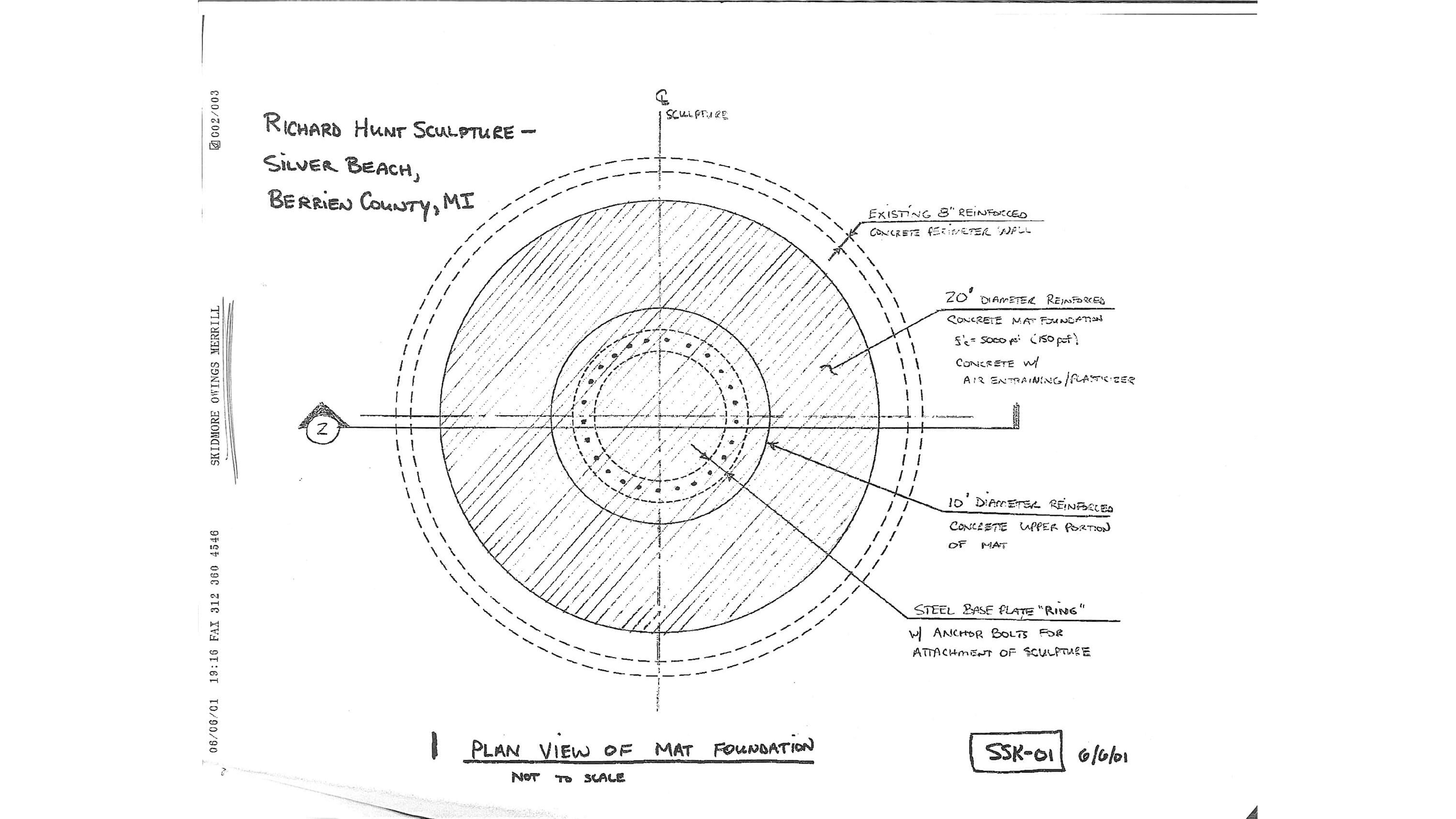
DRAFT 1 PLAN DRAWING
A mat foundation is a large, continuous slab of reinforced concrete that spreads the pressure of the load on top of it across the surface below. It is often used for areas where the soil is unstable or the ground might move. The original mat foundation planned for And You, Seas would have succeeded in distributing the pressure of the sculpture wide across the soil underneath, but it also would have put additional pressure on the wall of the channel nearby.
Documents courtesy of Skidmore, Owings & Merrill, Chicago, IL.
Read the drawing description
The overhead view shows the existing perimeter wall surrounding a 20-foot-diameter concrete mat and its raised 10-foot-diameter central portion. A steel base-plate ring and anchor bolts connect the sculpture near the center. A line through the middle marks the location of the preceding section drawing.
Documents courtesy of Skidmore, Owings & Merrill, Chicago, IL.
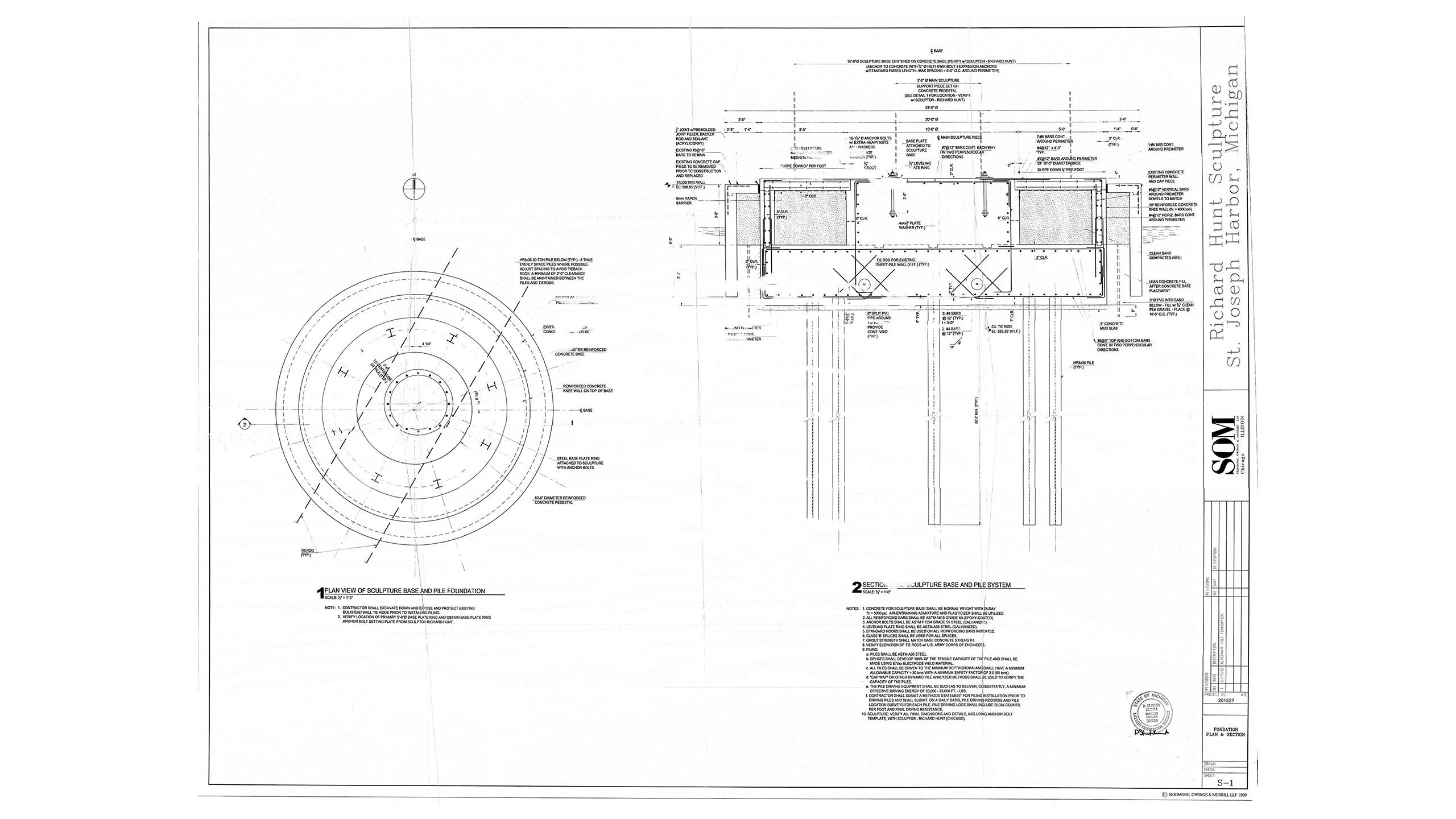
FINAL ENGINEERING CONCEPT
A deep foundation distributes loads down under the surface of the ground using a vertical structure – in this instance, piles, which are like poles. The new pile foundation design prevents the pressure of the sculpture from pushing outward across the ground and instead directs the load deeper underground much like the foundation of a skyscraper.
Documents courtesy of Skidmore, Owings & Merrill, Chicago, IL.
Read the drawing description
The overhead view places eight steel piles around the central sculpture support. The side cutaway shows the piles extending downward beneath the reinforced-concrete base. The sculpture is anchored to a central pedestal. Unlike the earlier shallow mat proposal, the piles transfer loads deeper into the ground.
Documents courtesy of Skidmore, Owings & Merrill, Chicago, IL.
NOTES & EQUATIONS
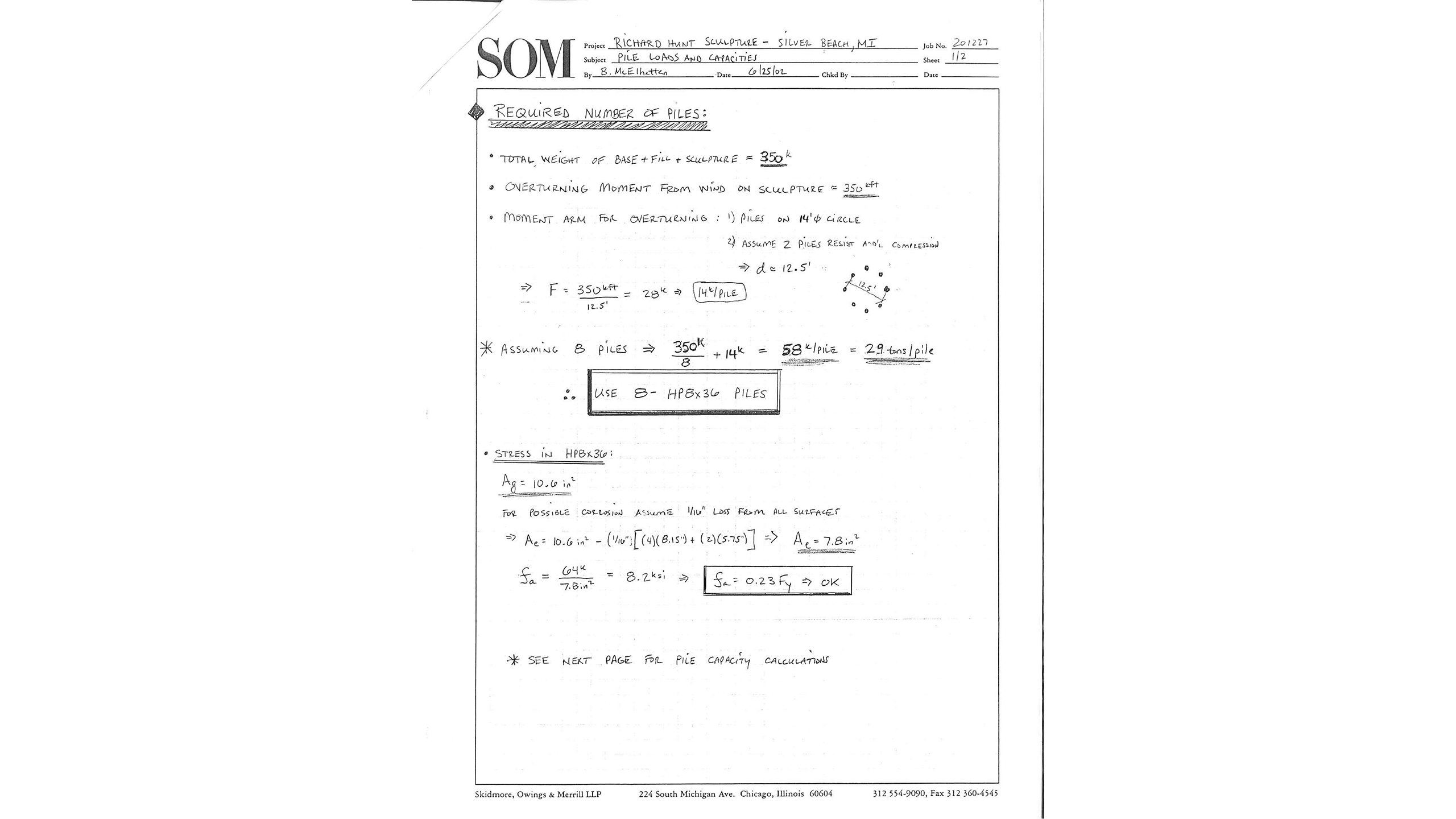
Ever wonder why your teachers made you show your work? These handwritten notes and equations explain the designers’ process for identifying how many piles (or poles) would be needed to support And You, Seas and how much force they would bear.
Documents courtesy of Skidmore, Owings & Merrill, Chicago, IL.
Read the drawing description and calculations
The sheet lists a combined weight of 350 kips for the base, fill, and sculpture. One kip equals 1,000 pounds of force. The estimated wind overturning moment is 350 kip-feet. Dividing this by a 12.5-foot moment arm gives 28 kips; assigning that additional load to two piles gives 14 kips per pile.
For eight piles, 350 divided by 8, plus 14, gives approximately 58 kips, or 29 tons, per pile. The sheet specifies eight HP8×36 steel piles.
The corrosion allowance reduces the calculated steel cross-sectional area from 10.6 to 7.8 square inches. The subsequent stress check uses 64 kips divided by 7.8 square inches, giving approximately 8.2 ksi (thousand pounds per square inch). The sheet labels this as 0.23 times the steel’s yield strength and marks it “OK.”
The original document also refers to a further sheet for pile-capacity calculations.
Documents courtesy of Skidmore, Owings & Merrill, Chicago, IL.
CONTINUE EXPLORING
ART: A NEW PERSPECTIVE
Look closely at the sculpture through a 360-degree view and art resources.
FABRICATION: A NEW PERSPECTIVE
Watch the processes that turn sheet metal into organic sculptural forms.
HISTORY: A NEW PERSPECTIVE
Explore St. Joseph and Benton Harbor’s relationship with the water.
LITERATURE: A NEW PERSPECTIVE
Listen to the poetry that inspired the sculpture’s title.
PUBLIC ART FROM FIVE PERSPECTIVES
Explore Richard Hunt’s And You, Seas through art, physics, fabrication, history, and literature.
PROJECT SUPPORT
Support for Public Art from Five Perspectives is generously provided by Art Bridges.
MEMBERS GET MORE
Join Krasl and get closer to the art, artists, and experiences you love. Members enjoy Art Fair perks, early and discounted studio experiences, exhibition invitations, Shop savings, and even more benefits at higher membership levels.